
Terminal yard space is tighter today than ever before. Global trade volumes are surging, pushing ports and inland logistics hubs to face unprecedented congestion. Poor stacking in these high-pressure environments causes severe accidents and damages valuable cargo. It also slows down daily operations significantly. A loaded container handler steps in to solve this critical bottleneck. Specifically, these robust machines provide the safe, agile, and precise container stacking required to keep supply chains moving. In this comprehensive guide, we will explore how advanced equipment guarantees perfect accuracy, turning chaotic yards into highly efficient storage grids.
Key Takeaways
- Precision Technology: Modern equipment utilizes advanced anti-sway technology and smart spreaders to ensure perfectly aligned container placement.
- Maximized Space: High stack accuracy allows terminals to safely stack containers up to 5 or 6 tiers high, drastically improving yard space utilization.
- Heavy Load Stability: A 45-ton capacity machine provides the perfect balance of weight distribution and boom strength to handle fully loaded containers without compromising precision.
- Enhanced Visibility: Ergonomic, movable cabins give operators an unobstructed view of the target stack, reducing human error.
- Operational ROI: Investing in premium container handling equipment reduces cargo damage, speeds up operations, and yields a high return on investment.
What is a Loaded Container Handler?
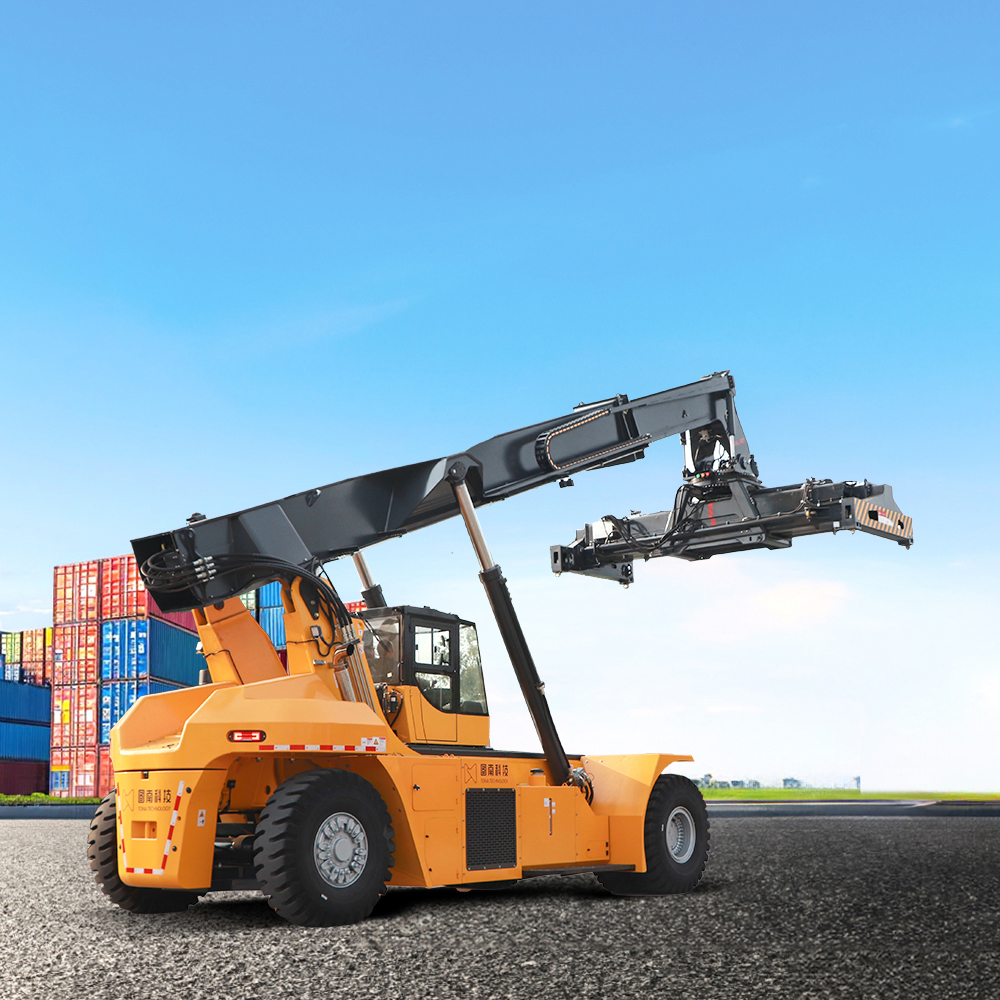
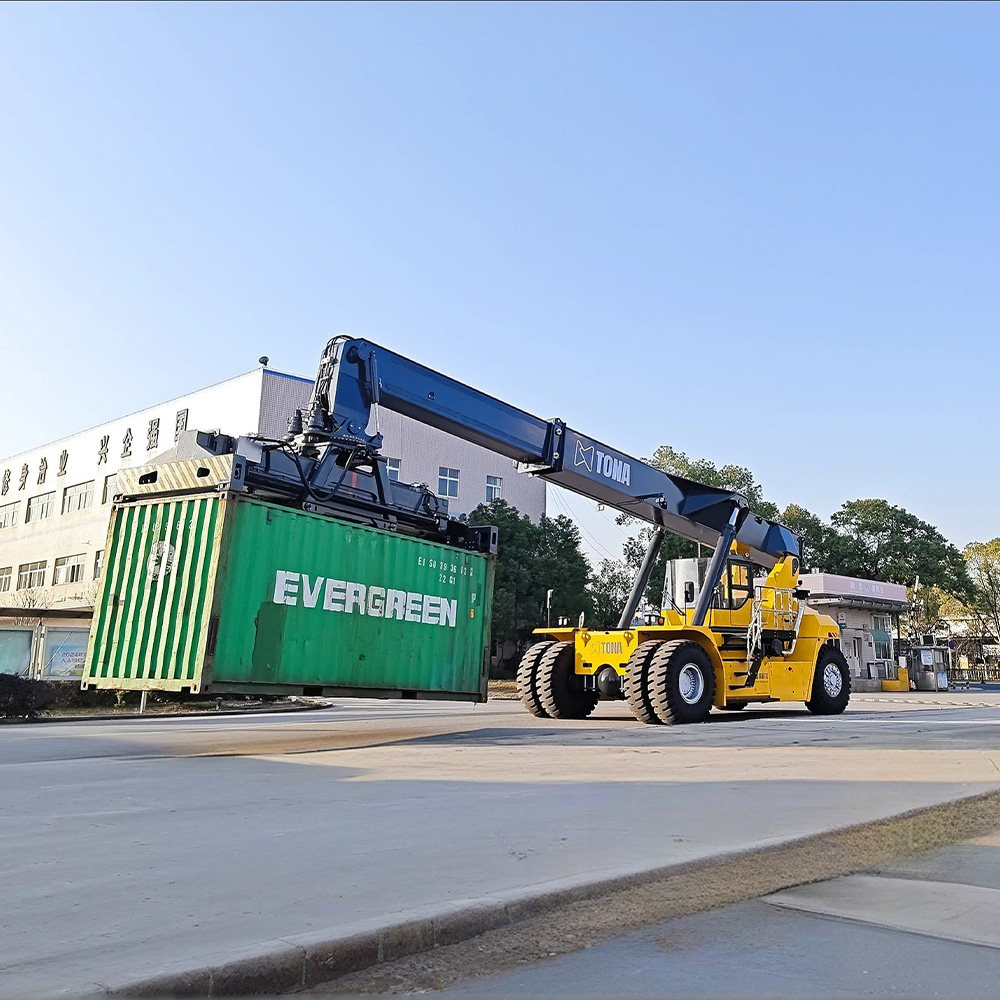
A loaded container handler is heavy-duty industrial equipment engineered specifically to lift, transport, and stack shipping containers at their maximum gross weight. Among the various types of handlers used in ports globally, the reach stacker stands out as the most versatile machine in modern logistics.
Its core function involves picking up fully loaded 20-foot or 40-foot shipping containers from trucks, railcars, or the ground, and stacking them in designated terminal yards. Over the decades, the evolution of this machine has been significant. Early container handling relied on basic heavy-duty forklifts. Those older models were heavily restricted in both forward reach and vertical stacking height. Today, modern equipment features telescopic booms and advanced electronic spreaders designed for absolute pinpoint accuracy.
It is crucial to differentiate between empty container handlers and loaded ones. While empty handlers are built for speed and high stacking of lightweight boxes, a loaded handler must safely manage up to 45 tons of dynamic weight. Handling such massive loads requires significantly more advanced engineering, a heavier chassis, and robust hydraulic systems.
Industry Trends: The Push for Vertical Density and Precision
Recent logistics industry analyses reveal a distinct operational shift. As mega-ships deliver unprecedented volumes of cargo in single calls, terminal operators are forced to drastically increase yard density. Rather than expanding horizontal footprints, which is often geographically impossible or financially prohibitive, ports are maximizing vertical space. This prevailing trend makes precision placement absolutely non-negotiable. The margin for error shrinks with every additional tier added to a stack.
Furthermore, the integration of semi-automated yard management systems demands that physical equipment matches digital precision. When a terminal operating system assigns a specific grid coordinate, the machine must place the box exactly on that mark. Consequently, manufacturers are upgrading hydraulic controls and load-sensing technologies to meet these stringent modern port requirements.
Why Stack Accuracy Matters in Container Yards
In highly congested ports and inland terminals, yard space is a premium asset. Perfect alignment allows terminal operators to safely stack containers closer together and higher up. By reducing the necessary clearance gaps between container rows and ensuring perfectly vertical stacks, terminals maximize their storage density per square meter. This high level of space utilization directly increases the operational capacity and profitability of the facility.
Beyond space, the physics of a poorly stacked container present severe safety hazards. Shipping containers are structurally designed to bear immense vertical weight exclusively on their four corner castings. If a container is misaligned, the structural integrity of the entire stack is compromised. Even a slight misalignment at the bottom tier can shift the center of gravity. This imbalance might cause a multi-tier stack to buckle or collapse under high winds or ground vibrations. Such catastrophic failures endanger terminal personnel, destroy expensive cargo, and lead to massive liability claims.
Precise stacking on the first attempt eliminates the need for costly re-handling. Forced adjustments waste fuel. They also drain operational time. Accurate initial placement accelerates the overall workflow of the terminal. It ensures that inbound and outbound trucks and railcars are processed without unnecessary delays.
How a 45 Ton Container Reach Stacker Ensures Precision Stacking
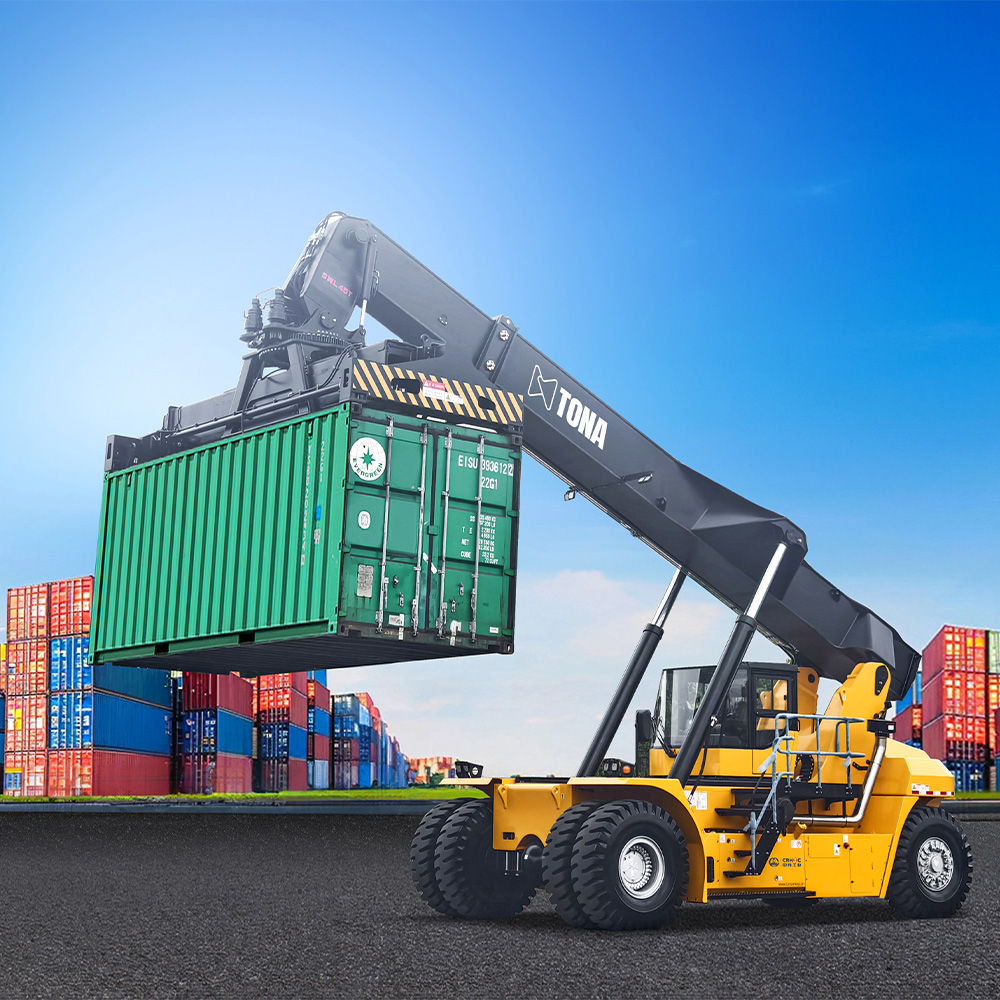
The industry standard for handling fully loaded 20-foot and 40-foot shipping containers is the 45-ton capacity machine. A 45 ton container reach stacker provides the optimal balance between lifting power, maneuverability, and structural stability. Because standard loaded containers rarely exceed 30 to 35 tons, the 45-ton capacity provides a necessary safety margin. This buffer prevents structural strain, making it the undeniable sweet spot for most inland ports and maritime terminals.
Precision stacking requires absolute machine stability. Imagine navigating a heavy machine while suspending a fully loaded 40-foot box high in the air. When that 45-ton load is extended forward into the second or third row of a stack, the equipment's center of gravity shifts dramatically forward. To counteract this intense leverage, premium machines utilize a massive, heavy-duty steel chassis combined with strategic rear counterweights. High-end models often integrate world-class drivetrains, like Kessler drive axles and robust Clark transmissions, ensuring smooth power delivery without chassis jerking. This highly engineered weight distribution prevents the machine from tipping or swaying.
Unlike traditional vertical masts found on standard forklifts, the telescopic boom operates on advanced hydraulic cylinders. This allows the boom to extend and retract smoothly under immense hydraulic pressure. The dynamic control of the boom enables the operator to make micro-adjustments in mid-air. By extending or retracting the boom at precise millimeter increments, the operator aligns the suspended container seamlessly with the locking cones of the stack below it.
Key Features That Improve Lifting Accuracy
The spreader is the critical rectangular attachment at the end of the boom. It grips the container's corner castings using mechanical twist-locks. Modern spreaders, such as those from industry leaders like Elme, are equipped with advanced side-shift, rotation, and forward-reach capabilities. Side-shift allows the spreader to move laterally left or right, while rotation allows for angular adjustments up to several degrees.
These mechanical features empower the operator to align the container precisely with the stack without having to reverse, steer, or reposition the entire massive vehicle. In addition, smart spreaders feature electronic seating sensors. These sensors prevent the twist-locks from engaging or disengaging unless all four corners are perfectly aligned. This safety interlock effectively eliminates the risk of dropped loads.
High winds and sudden mechanical movements cause heavy suspended containers to swing like a pendulum. A swinging 30-ton container makes accurate stacking nearly impossible and highly dangerous. To combat this, modern machines utilize electronic sensors and hydraulic damping systems to stabilize the load. Hydraulic accumulators act as shock absorbers, mitigating the kinetic energy of the swinging container. By dampening these oscillations automatically, the anti-sway systems ensure the load lands accurately on the target.
Beyond mechanical features, the human element remains a critical factor in stack accuracy. If an operator cannot see the target, they simply cannot stack accurately. Advanced models feature sliding or elevating operator cabins. By mechanically moving the cabin forward along the chassis or raising it vertically, the operator gains an unobstructed line of sight to the top tiers of the container stack. This ergonomic design eliminates dangerous blind spots during high-stacking operations.
Heavy Duty vs. Ultra Heavy Duty Reach Stacker: Which Offers Better Accuracy?
When optimizing a terminal for precise container placement, procurement managers often must choose between standard heavy-duty models and ultra-heavy-duty configurations. Understanding the engineering differences between these two categories is critical for maintaining stack accuracy under varying operational stresses.
While standard operations rely on a heavy duty container reach stacker to manage typical ISO shipping containers with agility, specialized industrial applications demand something more robust. Standard models typically max out at 45 tons in the first row. In contrast, an ultra heavy duty reach stacker features a reinforced chassis, elongated wheelbases, and specialized boom structures. These heavyweights are capable of handling oversized flat racks, dense industrial components, or tandem container lifts.
A common misconception in port logistics is that larger, heavier machines are inherently clumsier and less accurate. Empirical operational data proves otherwise. Stack accuracy at maximum extension is largely dictated by boom deflection. Deflection is the natural bending of the steel when subjected to massive weight.
Because ultra heavy-duty models utilize thicker, high-tensile steel and operate with higher-capacity hydraulic cylinders, they experience significantly less boom deflection when handling a standard 45-ton load. Less deflection translates to a more rigid, predictable lift. This rigidity allows the operator to align the container with pinpoint precision. However, for standard daily operations, a high-quality heavy-duty model is perfectly calibrated to provide zero-tolerance accuracy without the added fuel consumption and footprint of an ultra-heavy model.
| Operational Parameter | Standard Heavy Duty Model | Ultra Heavy Duty Model |
|---|---|---|
| Primary Cargo Type | Standard 20ft / 40ft ISO Containers | Oversized, Industrial, Tandem Lifts |
| Average Load Weight | 25 to 45 Tons | 45+ Tons or extreme eccentric loads |
| Yard Space | Tight aisles, requires high maneuverability | Wide aisles, requires maximum stability |
| Boom Deflection at 45t | Minimal, within standard ISO tolerances | Virtually zero, highly rigid |
Best Practices for Maximizing Stack Accuracy
Even the most technologically advanced equipment cannot overcome poor operational practices. Achieving perfect stack accuracy requires a holistic approach that combines skilled operation, rigorous yard maintenance, and proactive machine calibration.
The human element remains the most critical variable in stack accuracy. Operators must undergo comprehensive simulator and practical training to understand the machine's load charts. A load chart dictates exactly how much weight the machine can safely lift at various boom angles and extensions. Attempting to place a heavy container beyond the recommended reach radius forces the machine's hydraulic safety systems to intervene. This results in jerky, inaccurate movements. Operators trained to position the chassis at the optimal distance from the stack ensure smooth, fluid boom extensions.
The physics of high-tier stacking magnify ground-level imperfections. If a machine is operating on uneven ground, the entire chassis tilts. Consider the geometry. A mere 2-degree lateral tilt at the tires translates to a horizontal deviation of over 30 centimeters at the height of a fifth-tier container. This misalignment forces the operator to rely heavily on the spreader's side-shift function. Relying on side-shift wastes valuable seconds and increases the risk of a corner casting missing its locking cone. Maintaining flat, debris-free, and well-paved terminal yards is a non-negotiable prerequisite for precision stacking.
Stack accuracy degrades over time if the machine's mechanical and electronic components are not strictly maintained. Instead of relying on visual checks, maintenance crews should regularly use gauges to ensure pneumatic tire pressure is perfectly uniform. This prevents subtle chassis tilt. Regularly calibrating the spreader's electronic seating sensors and servicing the hydraulic proportional valves ensures the machine responds predictably to operator inputs.
The ROI of Investing in High-Precision Equipment
Procuring high-precision container handling equipment requires a significant capital expenditure. However, terminal operators must evaluate this investment through the lens of long-term return on investment. High stack accuracy generates measurable financial returns across three primary categories: cargo protection, operational speed, and asset longevity.
Poor stack accuracy is the leading cause of container drops, crushed roofs, and localized structural damage. A misaligned container places thousands of kilograms of asymmetric stress on the container beneath it. Consider a terminal processing 100,000 TEUs annually. If inaccurate stacking results in a 0.5 percent damage rate, the terminal faces 500 potential damage claims. At an average claim value of $2,000, the annual liability reaches $1,000,000. Upgrading to a machine with advanced anti-sway and micro-adjustment capabilities can reduce this error rate to near zero.
In port logistics, seconds compound rapidly. A machine lacking advanced precision technology requires the operator to make multiple corrective movements to align a container on the fifth tier. If a high-precision machine saves just 15 seconds per lift by enabling perfect, first-time placement, the operational savings are massive. This reduction in operating hours directly lowers fuel consumption, reduces operator overtime, and allows the terminal to process trucks and trains faster.
| Metric | Standard Machine with Multiple Corrections | High-Precision Machine with First-Time Accuracy |
|---|---|---|
| Average Time to Align 5th Tier | 45 Seconds | 30 Seconds |
| Time Saved Per Lift | 0 Seconds | 15 Seconds |
| Lifts Per Day | 200 | 200 |
| Hours Saved Annually over 300 Days | 0 Hours | 250 Hours |
Accurate, fluid movements put significantly less mechanical stress on the machine. Jerky corrections, sudden stops, and forced side-shifting while under heavy load accelerate metal fatigue in the boom. These rough movements also cause premature wear on the spreader's twist-locks. By investing in equipment that facilitates smooth, accurate placement, terminals extend the lifecycle of the machine itself.
Conclusion
Stack accuracy is the foundational pillar that builds safe, efficient, and profitable container terminals. Modern equipment offers superior lifting heights, advanced anti-sway technology, and ergonomic visibility enhancements. These robust machines ensure perfect container placement on the first attempt, mitigating risks and accelerating yard throughput. This meticulous engineering makes them the ultimate loaded container handler for modern logistics operations. If your terminal is struggling with yard congestion or inefficient stacking, it is time to evaluate your current fleet. Discover the perfect balance of power and precision by exploring the advanced container handling solutions available at Tona-Tec, and upgrade your operations with high-precision models engineered for absolute reliability.
FAQ (Frequently Asked Questions)
How high can a standard 45 ton machine stack loaded containers?
Most standard 45-ton models are engineered to stack fully loaded 9'6" High Cube containers up to 5 tiers high in the first row. In the second row, due to the extended reach radius and shifting center of gravity, the capacity typically allows for stacking up to 4 tiers high. Third-row stacking is generally limited to 3 tiers high, often with a reduced weight capacity such as 15 to 20 tons. Exact capabilities depend heavily on the specific machine's wheelbase, counterweight configuration, and the manufacturer's load charts.
How does the equipment prevent a container from swaying in high winds?
Modern machines combat load sway through a combination of mechanical design and intelligent hydraulics. Mechanically, the spreader is attached to the boom via a highly rigid rotator and damping cylinders. Hydraulically, the machine utilizes proportional valves and electronic load-damping systems. When the machine moves or stops suddenly, or when a gust of wind hits the container, these hydraulic cylinders actively absorb and counteract the kinetic energy. This stabilizes the load and ensures the container remains perfectly horizontal.
Can the machine handle misaligned containers?
Yes. Precision stacking is largely facilitated by the spreader's articulation capabilities. If a container on the ground or on a truck chassis is misaligned, the operator does not need to reposition the entire 70-ton machine. Advanced spreaders feature a side-shift function and a rotation function. These features allow the operator to make precise mid-air micro-adjustments, aligning the twist-locks perfectly with the corner castings of a skewed container.
What is the difference between an empty container handler and a loaded container handler?
The primary difference lies in structural reinforcement, weight distribution, and lifting mechanics. Empty container handlers are lightweight, highly agile machines designed for speed. They handle containers weighing no more than 8 to 10 tons. Because they deal with light loads, they do not require massive counterweights. A loaded container handler must safely maneuver up to 45 tons. Therefore, it requires a heavily reinforced chassis, a much larger wheelbase, massive rear counterweights, and heavy-duty hydraulic cylinders to prevent tipping.
When should a port upgrade to an ultra heavy duty model?
A port should consider upgrading to an ultra-heavy-duty model when standard 45-ton machines are consistently pushed to the absolute limits of their load charts. Indicators include a high volume of specialized industrial cargo, frequent handling of oversized flat racks with eccentric centers of gravity, or the need to perform tandem lifts. Additionally, terminals located in regions with severe, sustained high winds may benefit from the wider stance and heavier overall mass of an ultra-heavy-duty model. The increased rigidity minimizes boom deflection and improves safety margins during high-tier stacking.
What is the fuel consumption impact of precise stacking?
Precise stacking significantly reduces overall fuel consumption. When an operator places a container perfectly on the first attempt, the engine spends less time running under high hydraulic load. Conversely, constant repositioning, excessive side-shifting, and boom micro-adjustments force the engine to burn additional diesel. By eliminating these redundant movements, a high-precision machine can save thousands of liters of fuel annually per unit.
How does spreader side-shift work on a loaded handler?
Spreader side-shift is a hydraulic function that allows the entire spreader frame to slide laterally left or right, typically up to 800 millimeters in either direction. Heavy-duty hydraulic cylinders mounted on the spreader attachment execute this movement. This allows the operator to perfectly align the twist-locks with the container's corner castings without having to physically steer and reposition the massive chassis of the machine.
Related Blogs
-
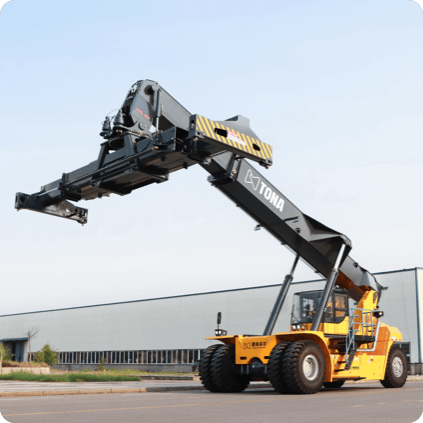 Operating heavy reach stackers requires robust ground to handle massive axle loads. This guide details essential pavement and safety standards to prevent equipment rollovers.
-
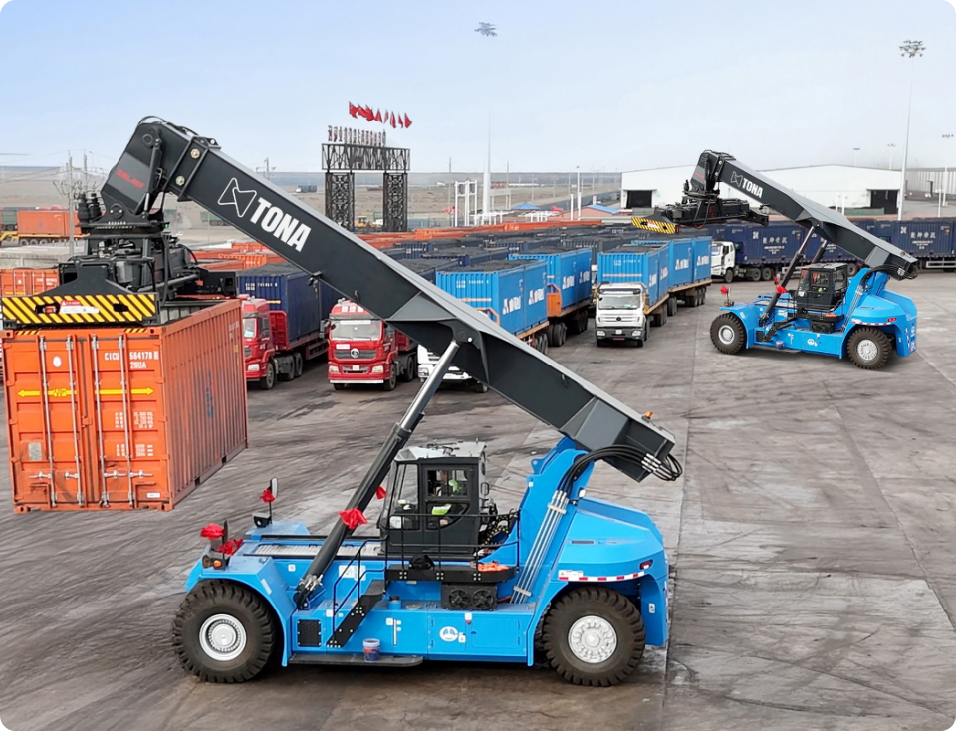 Prevent terminal collisions. Learn to calculate dynamic reach stacker safety zones, assess ground conditions, and safely optimize yard layouts.