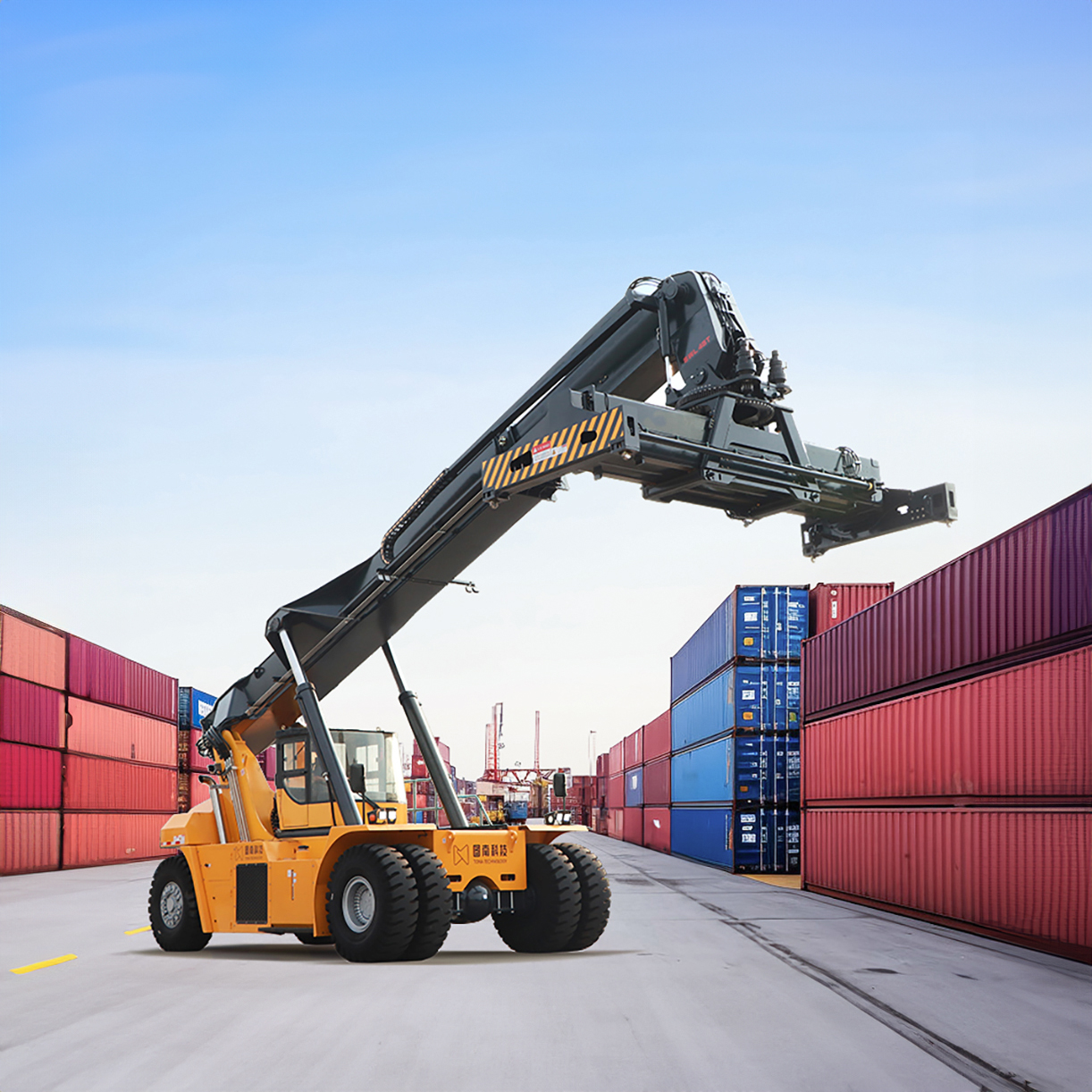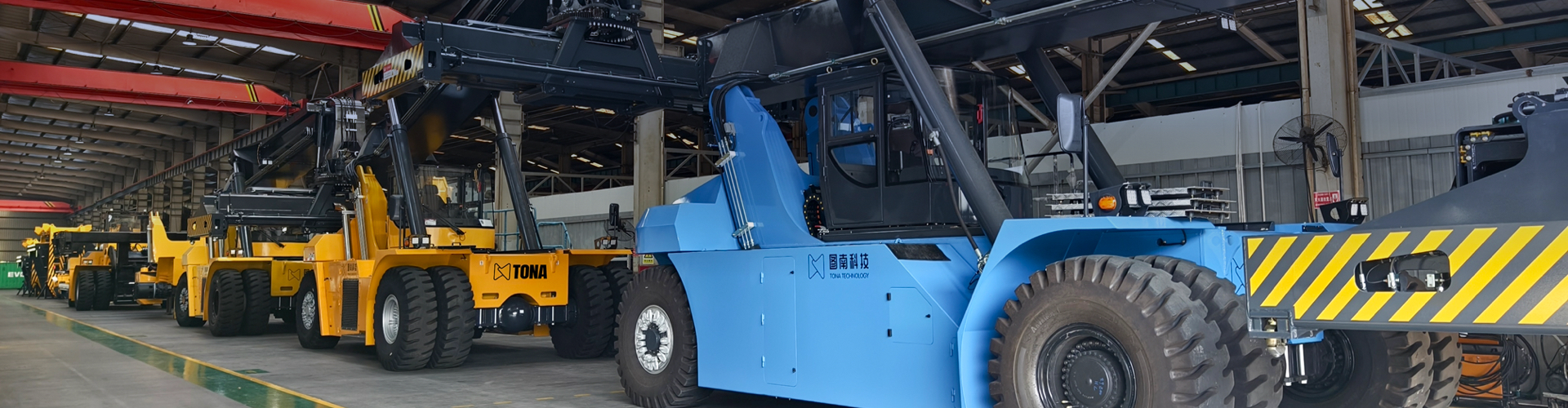

Operating a reach stacker safely is not a single action but a layered process that begins long before the ignition key turns. Because these machines lift 45 t more than 15 m high, a small lapse quickly becomes a catastrophic or costly event. The checklist below translates global best practices into a field-ready routine you can adopt tomorrow morning.
Pre-Shift Inspection: Minutes That Save Hours
Start at ground level and move upward:
Tires & rims: No circumferential cuts longer than 25 mm; 1 mm bulge = immediate replacement.
Hydraulic oil: Sight glass must read between min–max at cold idle; a 5 % drop in oil level can cut lift speed 12 %.
Twist-locks: Cycle each lock by hand; 3 mm wear on the cam nose equals 1 t lost clamping force.
Boom & chains: Look for shine on link plates—early sign of overloading.
Fire suppression pull-cable: Tug-test; a seized cable renders the bottle useless.
Cab Set-Up: Ergonomics Equal Alertness
Adjust seat suspension so your thigh angle is 100–110°; reduces lower-back fatigue on 12-hour shifts.
Set mirrors to “just overlap” the rear tires; blind-spot incidents drop 30 % when operators see tire edge.
Calibrate load moment indicator (LMI) to zero with empty spreader; a 1° sensor offset can hide 2 t of overload.
Starting the Reach Stacker: Cold-Engine Protocol
Idle at 800 rpm for 3 min, then raise boom to 30° for another 2 min. This circulates oil through the boom cylinders and prevents cavitation when you demand full flow. Skipping this step cuts pump life by up to 15 %.
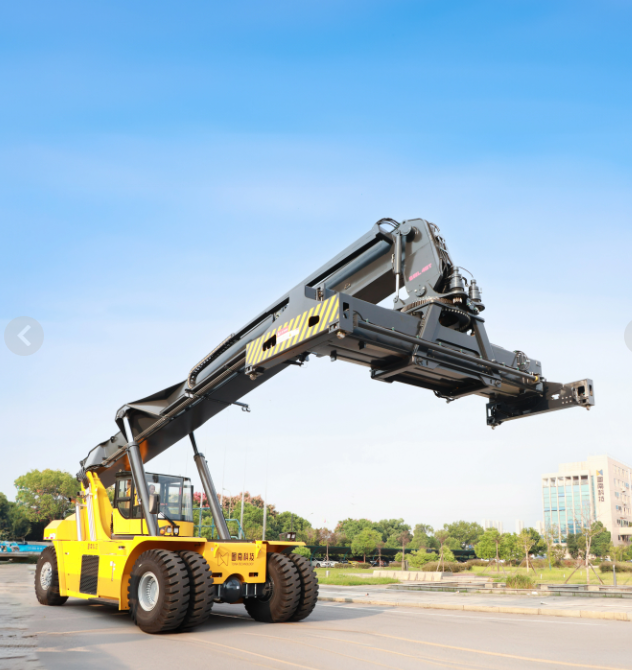
Pick & Place Cycle: The Arc Method
Imagine every lift as an arc, not a straight line:
Approach: Stop 0.6 m short, align center of gravity.
Engage: Lower spreader until pads touch, wait 1 s, then activate twist-locks; the pause removes side-load on pins.
Elevate: Raise to 0.5 m “travel height” only—higher increases swing inertia.
Travel: Keep boom angle ≤ 35°; at 45° dynamic overload can jump 8 %.
Land: Touch down, count “one-thousand-one,” release locks; prevents “snatch” damage to corner castings.
Visibility & Pedestrian Control
Use white-noise reverse alarms (broadband 400–4000 Hz) instead of tonal beep; pedestrians locate direction 40 % faster.
Activate cab roof amber strobe whenever boom > 2 m high; gives 360° warning even behind stacks.
Establish 3 m “red-line” buffer with floor paint around travel paths; 70 % of struck-by injuries occur inside this zone.
Load Stability in High Winds
At 25 km/h wind speed, a 40 ft empty container exerts 0.9 t side force—enough to tip a reach stacker on 1.5 % grade. Reduce allowable stack height by one tier for every 10 km/h above 30 km/h.
Emergency Scenarios: Quick-Reference Actions
| Event | Immediate Action | Follow-Up |
|---|---|---|
| Loss of hydraulics | Hold hoist lever in “lower” to open safety valves; gravity lowers load at 0.3 m/s | Engage parking brake, shut down, tag-out |
| Fire in engine bay | Pull cab fire-suppression handle, exit within 15 s | Use handheld CO₂ for spot flames; report incident |
| Overload alarm | Stop lift, retract boom 5°, re-spread to 20 ft position if possible | Log weight, notify planner |
Refueling & Parking: End-of-Shift Discipline
Park on level ground, boom fully lowered, spreader locked to 20 ft to prevent sway. Leave 30 cm gap between tires to avoid flat-spotting. Refuel with engine off to prevent static-arc ignition; a 5 m hose grounding reel cuts static risk 90 %.
Training Cadence: Little-and-Often Beats Marathon Classes
Micro-learning—3-minute videos before each shift—boosts retention 40 % versus quarterly 8-hour courses. Add VR simulator drills twice a month; studies show operators make 25 % fewer errors after six VR sessions.
Digital Audit Trails: Prove Compliance in Clicks
Modern reach stackers export CAN-bus data (lift counts, overload events, idle time) to cloud dashboards. Review weekly; if overload events exceed 2 % of total lifts, schedule refresher training immediately.
Frequently Asked Questions
Q1: What is the minimum safe distance between a reach stacker and pedestrians?
A: Maintain a 3 m “red-line” buffer marked on the ground. Seventy percent of struck-by injuries occur inside this zone, so keeping clear distances sharply reduces accident risk.
Q2: How often should hydraulic oil levels be checked?
A: Inspect at the start of every shift when the machine is cold. A drop of only 5 % can reduce lift speed by 12 % and invite cavitation damage to the main pump.
Q3: Can a reach stacker work in strong wind?
A: Yes, but you must derate capacity. At 25 km/h a 40 ft empty already exerts 0.9 t side force; reduce allowable stack height by one tier for every 10 km/h above 30 km/h to stay within stability limits.
Q4: What immediate action should I take if the overload alarm sounds?
A: Stop the lift, retract the boom 5°, and re-spread to 20 ft if possible. After the load is safe, log the weight and notify the planner so the slot plan can be corrected.
Q5: Is a quarterly classroom enough for operator training?
A: Classroom-only training is insufficient. Micro-learning videos before each shift plus bi-weekly VR simulator drills cut real-world errors by 25 % and keep certifications compliant with ISO 23853.
Related Blogs
-
 If you’re wondering what is reach stacker, it’s a powerful vehicle designed to lift, move, and stack large shipping containers. You’ll often spot a reach stacker at ports, container terminals, and storage yards.hot blog
 -
 Reach stackers, also known as container handlers or intermodal handlers, are essential machines in material handling and logistics. They are equipped with a telescopic boom that allows for efficient lifting and stacking of containers at various heights. While reach stacker is the most common term, alternatives like container stacker and stacking crane emphasize different functionalities. The choice of terminology often depends on regional preferences, specific applications, or the machine's capabilities. Understanding these terms helps businesses select the right equipment for their operations. Whether lifting or stacking, reach stackers optimize container handling in ports, warehouses, and rail yards.
 -
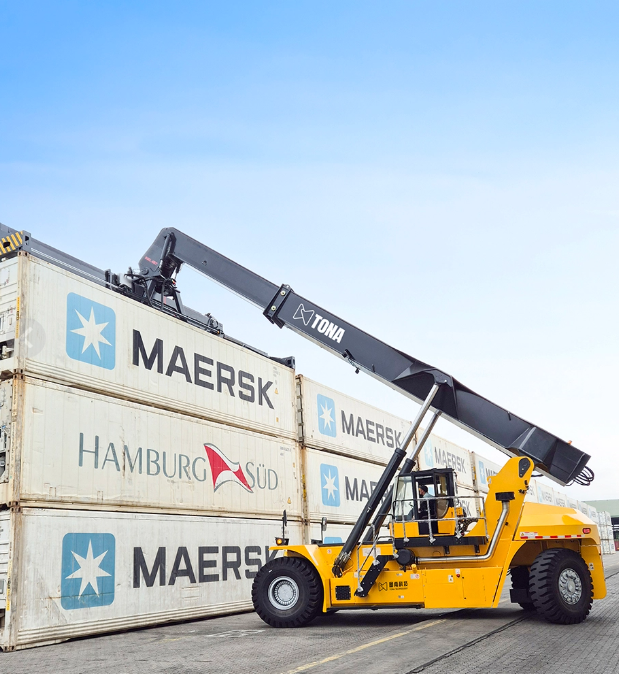 This article compares container handlers and reach stackers, two essential machines for container handling. It outlines their differences, including storage capacity, selectivity, and manoeuvrability. Container handlers excel in speed and efficiency for quick access to containers in narrow spaces, while reach stackers are ideal for maximizing storage density by stacking containers in multiple rows. The article discusses lifting capacities, cost considerations, and ROI for both machines, helping businesses choose the best option based on their specific needs. Reach stackers are recommended for operations focused on optimizing space, whereas container handlers are better for quick and efficient container movement.