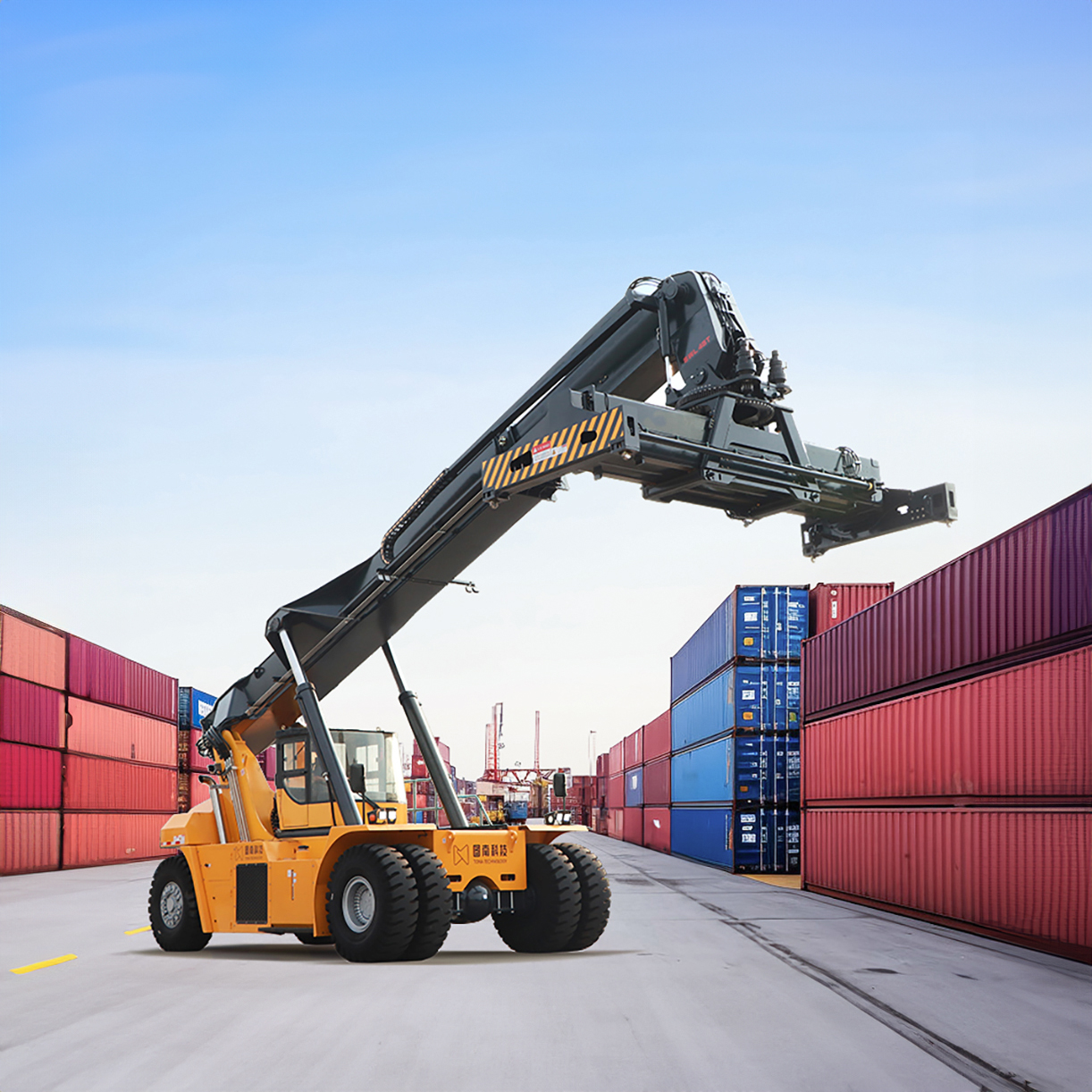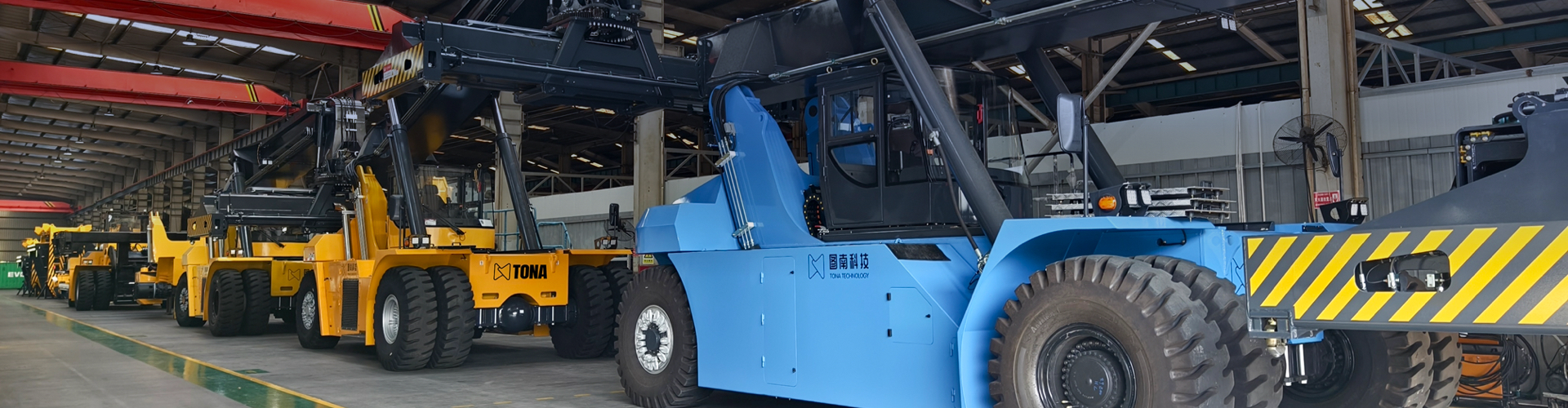

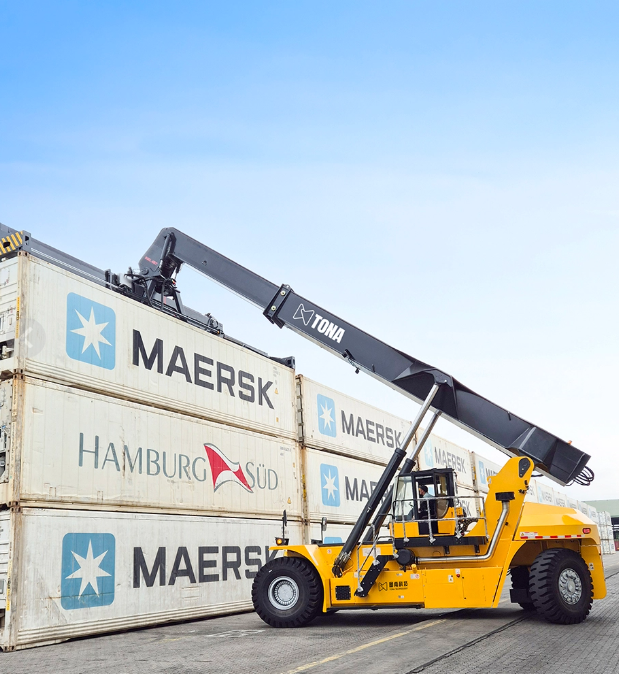
A reach stacker is the Swiss-army knife of container-handling equipment: it can lift, move, stack, and feed boxes faster and higher than a forklift yet costs a fraction of a full gantry crane. In modern container yards—especially medium-sized terminals, rail hubs, and intermodal facilities—the reach stacker has become the go-to machine for balancing speed, density, and capital expenditure.
What a Reach Stacker Actually Does in Day-to-Day Operations
At its core, a reach stacker is a mobile, rubber-tired vehicle with a telescopic boom that can “reach” over a row of containers to place the second or third box without moving the bottom one. This single capability unlocks a cascade of practical uses:
Loading/unloading road trucks: Drivers can drop or pick up a box in under three minutes, keeping gate queues short.
Creating dense storage blocks: By stacking 5-6 high and 3-4 deep, yards gain up to 40 % more TEU capacity on the same footprint.
Shuffling empties and reefers: Operators can segregate by size, weight, or temperature status on demand, something fixed-rail equipment struggles to do.
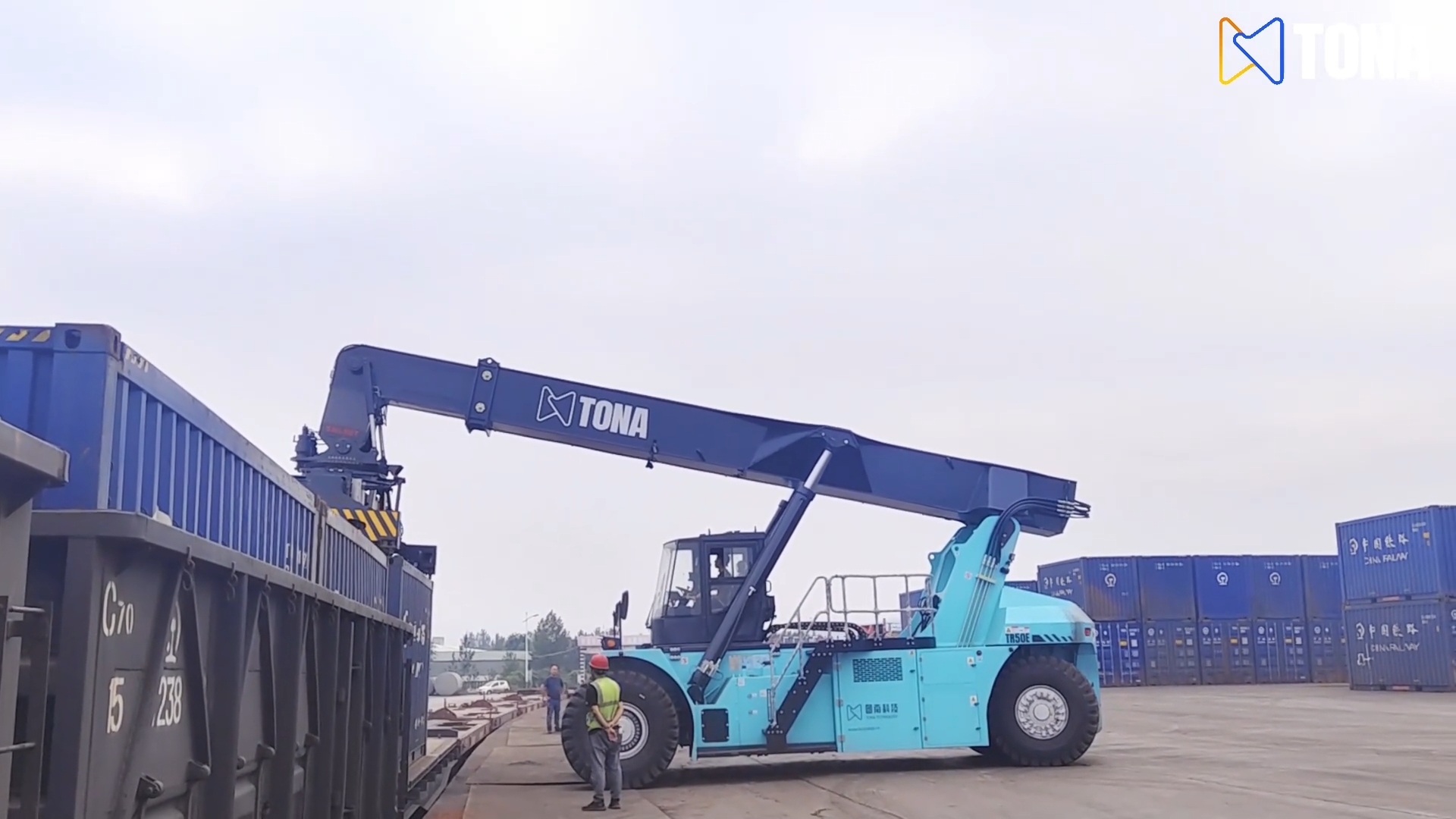
Feeding rail cranes: Reach stackers pre-stage boxes parallel to the track so that large rail-mounted cranes achieve continuous cycles.
Key Components That Drive Productivity
Understanding the hardware explains why the reach stacker is so versatile:
Telescopic boom: 8–16 m outreach allows second-row placement without repositioning the chassis.
Spreaders with 360° rotation: ISO floating twist-locks handle 20 ft, 40 ft, or twin-20 loads plus tilt angles for sloped ground.
High-torque diesel or hybrid driveline: 300–400 kW engines deliver 0–20 km/h in seconds while maintaining low-end lugging power for ramps.
Load-sensing hydraulics: Variable pumps cut fuel 12–18 % by delivering only the oil volume required for each lift.
Advanced stability triangles: Patented outrigger and counterweight geometry lets the machine stack 45 t at 6 high on a 6 % grade.
Typical Work-Flow Patterns in Container Yards
Terminals usually adopt one of three stacking strategies, each exploiting the reach stacker’s agility:
Pyramid stacking: Newest boxes sit on top; removals happen last-in/first-out—ideal for empties.
Slot segregation: Ground slots are numbered so any box can be fetched in under five minutes, balancing FIFO requirements.
Rail-fed buffering: Reach stackers build short “walls” perpendicular to the rail line; RMGs or RTGs pick from the far side, creating parallel workflows.
Comparative Economics: Reach Stacker vs. Forklift vs. RMG
| Metric | Reach Stacker | Heavy Forklift | Rail-Mounted Gantry |
|---|---|---|---|
| Capital cost (USD) | 0.8–1.2 M | 0.4–0.6 M | 5–7 M |
| Max lift height | 6–7 containers | 3–4 containers | 15+ containers |
| Ground pressure | 7–8 t/axle | 12 t/axle | Fixed rail |
| Relocations/hour | 20–25 | 12–15 | 30–35 |
The table shows the reach stacker occupies a sweet spot: higher than a forklift, cheaper than an RMG, and mobile enough to follow seasonal demand peaks.
Safety and Operator-Aid Technologies
Modern reach stackers ship with camera-radar fusion, RFID slot verification, and overload prediction software. These aids cut container damage by 35 % and near-miss reports by half, directly lowering insurance premiums.
Maintenance Tips to Keep Total Cost of Ownership Low
Change hydraulic return filters every 500 hours to avoid pump cavitation.
Calibrate boom angle sensors quarterly; drift causes mis-picks that bend twist-locks.
Rotate tires at 50 % wear; uneven tread reduces stability alarms and avoids early replacements.
Use telematics to track idle time; every 10 % idle reduction equals ~900 L of diesel saved per year.
Future Trends: Hybrid Power and Automation
Manufacturers are piloting lithium-ion battery packs that supplement the diesel engine during peak lifts, cutting CO₂ output 25–30 %. Remote-control and semi-autonomous reach stackers are also undergoing live tests in European ports, promising predictable cycle times and reduced labor fatigue.
Conclusion
Whether you run a small inland depot or a busy intermodal hub, a reach stacker delivers the fastest payback in the container-handling fleet. By stacking higher, moving quicker, and requiring minimal civil works, it turns limited real estate into profit—today and for the next decade.
Related Blogs
-
 If you’re wondering what is reach stacker, it’s a powerful vehicle designed to lift, move, and stack large shipping containers. You’ll often spot a reach stacker at ports, container terminals, and storage yards.hot blog
 -
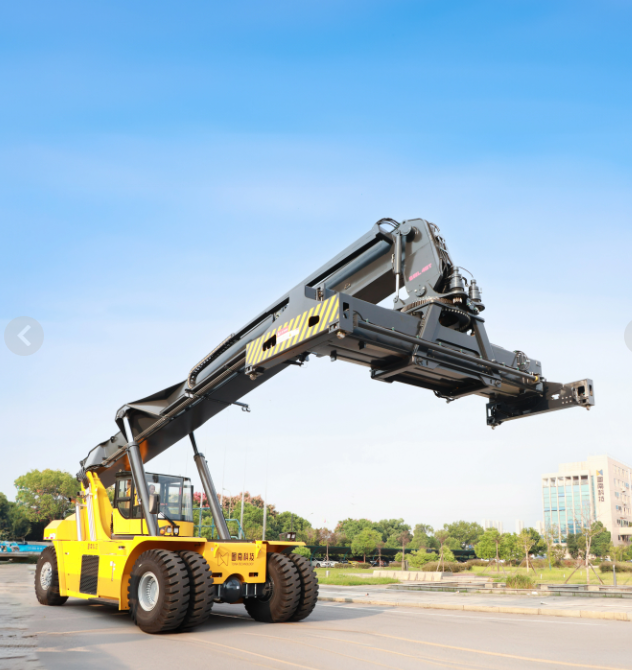 Reach stackers, also known as container handlers or intermodal handlers, are essential machines in material handling and logistics. They are equipped with a telescopic boom that allows for efficient lifting and stacking of containers at various heights. While reach stacker is the most common term, alternatives like container stacker and stacking crane emphasize different functionalities. The choice of terminology often depends on regional preferences, specific applications, or the machine's capabilities. Understanding these terms helps businesses select the right equipment for their operations. Whether lifting or stacking, reach stackers optimize container handling in ports, warehouses, and rail yards.
 -
 This article compares container handlers and reach stackers, two essential machines for container handling. It outlines their differences, including storage capacity, selectivity, and manoeuvrability. Container handlers excel in speed and efficiency for quick access to containers in narrow spaces, while reach stackers are ideal for maximizing storage density by stacking containers in multiple rows. The article discusses lifting capacities, cost considerations, and ROI for both machines, helping businesses choose the best option based on their specific needs. Reach stackers are recommended for operations focused on optimizing space, whereas container handlers are better for quick and efficient container movement.